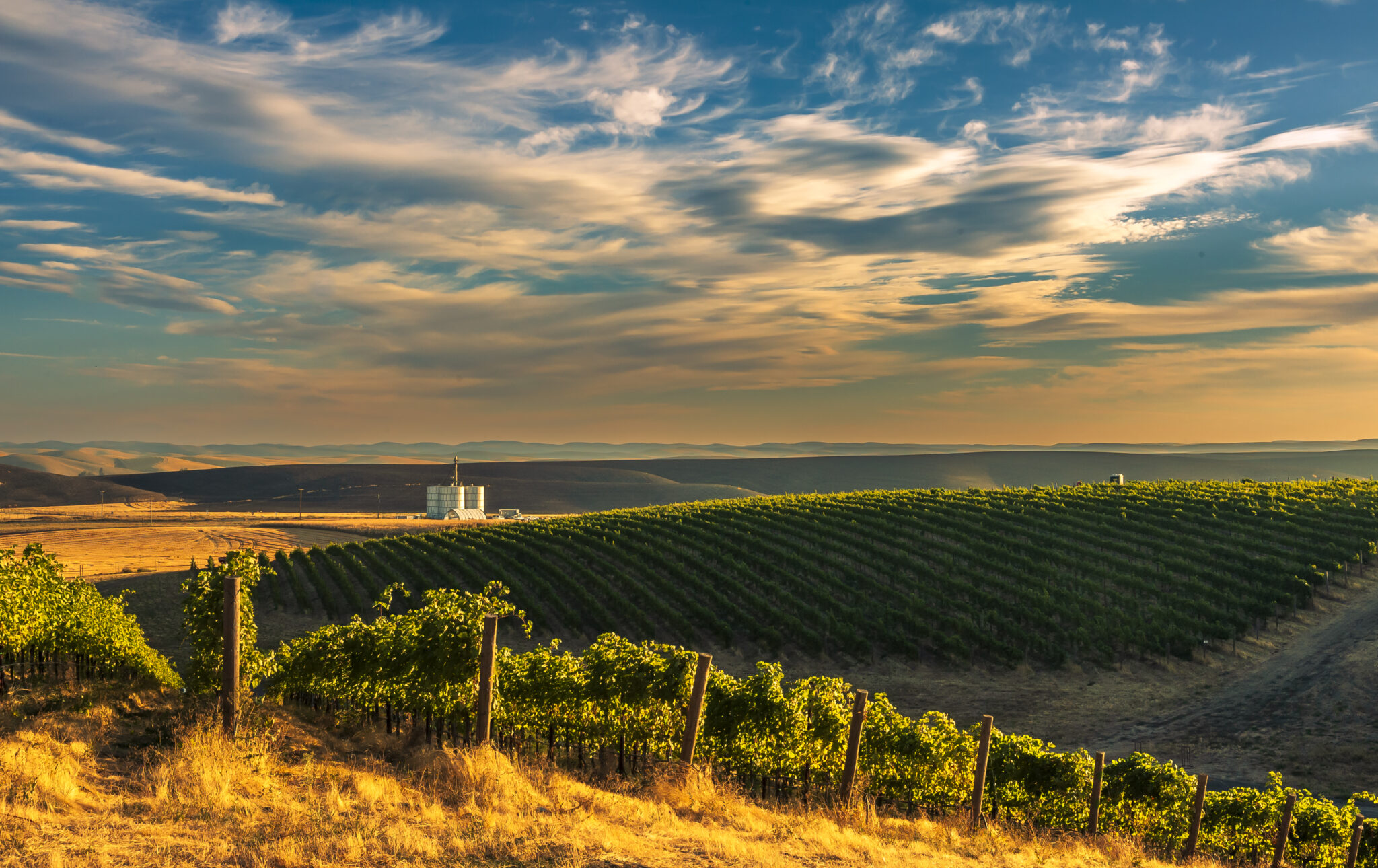
The name translates as easily as it rolls off the
tongue: Walla Walla. Many Waters. To the earliest
Native tribes, the many waters came from the nearby Blue
Mountains and gathered to form the Walla Walla River on
its way to join the Columbia to the west. The waters flowed
first; however, into a fair-sized Valley carved in the mountain's
foothills, and bordered in part by the terrain of what is
known as the Columbia Plateau. Tribal members knew the Valley's
generally milder climate could maintain their people in
winter villages. There were lush wild grasses which could
sustain horses and attract game from the winter snows of
the nearby Blues, or from the giant high plateau that becomes
desolate and dangerous during the cold season. The rolling
terrain and numerous watersheds offered protection from
nature and other hazards of the day. Here the water was
plentiful and full of fish and seldom froze, even in the
coldest years. The meadows were wonderful places to gather
with other people to trade, compete and celebrate treaties.
Compared to the region around them, the Walla Walla Valley
was a safe refuge from the treacherous conditions which
can often be found during the winter for hundreds of miles
around.
In this unique growing region, most of the earliest records
of grapes and winemaking reference the Italians who had
immigrated here in the mid to late 1800's and who brought
with them their tradition of growing, making and drinking
wine. Vines with these origins still exist in the Valley
today. The first post-prohibition winery was Blue Mountain
Vineyards. It was bonded in 1950 by the Pesciallo family
where they produced Black Prince and other Italian varietal
wines for a period of several years before succumbing to
economics and climate.
To the wine world of today, Walla Walla has become know
for the quality and style of its red wines, especially Cabernet
Sauvignon and Merlot with Syrah gaining notoriety in recent
years.
In the1970's, the pioneers of today's wine community began
to think similar thoughts: that the Walla Walla Valley,
with its long history of fruit growing, moderate climate,
wine-making heritage, and interesting terrain might just
be a place to grow vines and make wine on a commercial scale.
These pioneers of the region applied for and received approval
of the Walla Walla Valley as a unique American Viticultural
Area (AVA) in 1984. It was the third in Washington State
and also includes a portion of land in Oregon. In the time
leading to the recognition of the appellation, four wineries
had been bonded starting with Leonetti Cellar, and shortly
thereafter, Woodward Canyon. L'Ecole Nº 41 and Waterbrook
soon followed. In addition to the smaller vineyards that
were being planted, the Valley's first large-scale, commercial
vineyard Seven Hills was established.
By the time the BATF recognized the Walla Walla Valley
AVA, the Valley was beginning to gain attention from within
the wine industry, as well as, attracting publicity from
journalists and media outside the region. The foundation
for today’s industry had been laid and the benchmark
for quality had been set. In addition, fruit from the area
was now being harvested and a baseline for understanding
the local growing conditions was being constructed.
Every few years another winery would join the fold and
take up the challenge of producing the highest quality wine
and the growing of outstanding fruit. Seven Hills Winery
and Patrick M. Paul each got their start during this time.
More vines were added, although acreage increases were small
each year. The industry was small and everyone knew everyone
else involved, while the welcome mat remained out for any
newcomers. Growers and winemakers alike regularly shared
time in the cellar or at the table and together learned
more about wines and vines.
By 1990 there were just six wineries and the Valley's grape
acreage stood at perhaps 100 acres. The total collective
production of wine was microscopic by any measure, but it
was the quality that was being noticed by many inside and
outside the trade. As the tiny trickle of wine produced
in the Walla Walla AVA began to flow to the outside world,
a "wine renaissance" was beginning to happen globally.
The Pacific Northwest had staked a claim in this new wine
world and as people learned about the region, they also
began to hear about Walla Walla. This interest spread rapidly
to those with Walla Walla connections. The early 1990s saw
the planting of more vines and the establishment of another
large-scale vineyard, Pepper Bridge. At the same time, a
group of local investors, working closely with the Napa
based Chalone Wine group, laid the foundation for Canoe
Ridge Vineyard, the Valley's first winery supported in part
by a major outside investor.
As the industry has grown, many new wineries have gotten
their start in the arms of an established winery. Waterbrook
Winery's modern production facility started the trend, sharing
space, equipment, and any help needed. Other wineries also
adopted “extra guests,” a practice that has
helped form close, personal relationships throughout the
local industry.
By the turn of the new century, the Walla Walla Valley
wine industry had 22 wineries and 800 acres of grapes. In
the year 2000 the AVA had been expanded back to the original
boundaries proposed in the1984 application. The year 2000
also saw the formation of the Walla Walla Valley Wine Alliance
with 100% of the Valley's wineries and 98% of the Valley's
planted acreage represented.
Today, more than 60 Walla Walla Valley wineries and more
than 1,200 acres of Walla Walla Valley grapes contribute
to the ever growing, international acclaim garnered by the
wines of this newly-emerging region of Washington State.